
Man or Bear?
A question women should have been asked two millennia ago.

The “Man or Bear” TikTok debate has been on my mind for weeks. Not because I’ve been weighing my own options but because I’ve been weighing the options from the point of view of the women of history.
In the present tense, it’s a simple question that receives responses that are both revealing and polarizing.
Women: Would you rather encounter a bear or a man in the wilderness?
The flood of posts and comments show women prefer the bear an overwhelming percentage of the time.
Might this have been true from time out of mind?
Let’s rewind to the ancient world; there are so many examples we can examine.
A quick look at mythology and classical literature as a reference indicates yes. The stories passed down to us through the ages use the woman-encounters-a-man-or-animal-in-the-woods plot with such prevalence that it’s a tired trope.
The female characters in these stories — semi-divine nymphs and mere mortal women — rarely contribute enough dialogue for us to know exactly how they would respond to the man or bear question. There are three stories, chosen from among many equally illustrative examples, that demonstrate why ancient women and mythical female characters would probably have chosen the bear in their own time — if anyone had asked.
Bear in mind that these examples come from myth. They are outlandish compared to the real experiences women have shared in response to the question. And yet, some things ring uncomfortably true across the expanse of time.
I guess what I’m saying is: Don’t be put off by the fictional nature of these stories. The authors of mythical literature were trying to explain the world around them. Those works tell us more than where people thought lightning came from. They also tell us about the culture and values of the world at the time it was published.
Daphne + Apollo
In Greek mythology, the sun god Apollo becomes obsessed with Daphne, a nymph. Being a powerful god, Apollo pursues Daphne relentlessly. He can’t understand why a lesser being wouldn’t immediately acquiesce to his advances willingly, and he definitely can’t understand Daphne’s desperate attempts to evade him.
Her continual flight makes Apollo burn hotter with the desire to possess her. Sun god that he is, what other response can anyone expect of him? Honestly people! It’s just his nature. Don’t the mere mortals and minor deities get it?
Perhaps because she absolutely gets it, Daphne seeks intervention from dear old dad, the river god Peneus. He intercedes…by transforming Daphne into a laurel tree, ensuring her safety from Apollo, and simultaneously taking away her agency and voice, turning her into an object.
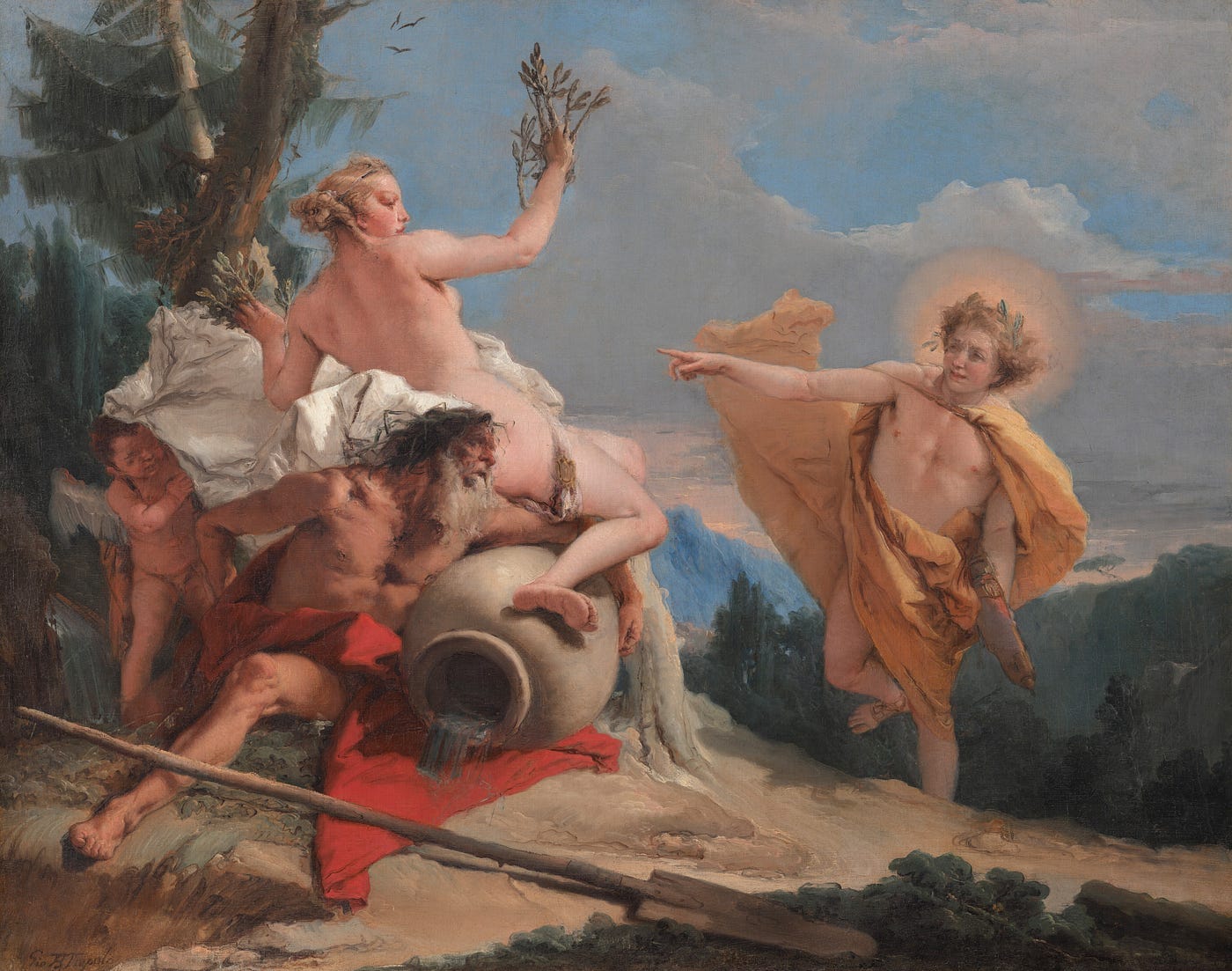
In some artists’ interpretations, Apollo snatches a sprig of laurel, which he is often depicted with. Read one way: the presence of the laurel signifies Apollo has stolen a piece of Daphne. Fleeing in fear from a relentless pursuer would steal a piece of anyone, starting with their peace of mind. So, the depictions of Apollo with the laurel sprig add an attribute to the standard meaning to include taking part of someone against their will.
Speaking of will, Daphne does not get to exercise hers. While her father, Peneus, saves her from Apollo’s advances, being turned into a laurel tree doesn’t seem like the kind of solution most women are looking for in this scenario. We can’t say what Daphne’s will is because ancient Greeks and Romans did not consider women’s perspectives relevant or additive to the plot.
Two millennia on, I hope most people have one of the following responses to the “help” Daphne receives:
Indigence — “If I were in Daphne’s sandals, my toga would be in a real twist if someone turned me into a botanical instead of offering help that let me maintain my original form!”
Total Confusion — “Uhhh…ok…I’m going to need someone to make it make sense.”
The perspective that could make it make sense is Daphne’s. But we don’t have that because some Greco-Roman editor redlined it. I’m being generous in believing those lines were written to begin with in order to be edited out.
If your brain is still going
Mine did, too.
Were laurels Daphne’s favorite?
Did dad just panic and turn her into her favorite thing?
Those are great writing prompts for a neo-mythical retelling of the story. In other words, we’ll have to make it up because we don’t know.
But you know what we do know? We know who loved laurels. Apollo.
Like a corporate vice president on a mission to increase their span of control, Apollo was the god of more than just the sun. He also represented music and prophecy. The laurel tree is a symbol of purification and prophecy. So, far from symbolizing something important about the woman in this story, the laurel tree represents something important to Apollo.
For me, the only thing that could be symbolically worse would be if Daphne became an apple tree that gave away her apples, her branches and limbs, had her torso branded, got cut down to a stump, and still straightened up so the person who stripped her of the resources she needed to grow and thrive had a proper place to sit.
Side note: I love so many of Shel Silverstein’s works…just not that one.
Apollo holds the symbols of prophecy sacred. Olympian gods have an ironclad rule that sacred things may not be defiled, thus preventing him from pursuing Daphne. Weirdly, his conscience about the sacred is part of what prevents him from further pursuit.
If you’re wondering where this conscience was earlier in the story when Apollo was not respecting Daphne, he blamed it on another god, Eros (Cupid), saying the guy hit him with an arrow, causing him to fall desperately in love with Daphne. What a convenient way to explain away his behavior. Think of this as one of humanity’s earliest instances of claiming, “The devil made me do it!”
As for Peneus, he ensures his daughter will be chaste — instead of chased — by turning Daphne into a botanical associated with purity. Let’s give credit where it’s due, however, because chastity and purity were important to Daphne, too. She was a devotee of Artemis, the goddess of the hunt, nature, women’s health, childbirth, and chastity.
Thought Exercise: It’s worth noting that Artemis is the twin sister of Apollo, which makes you wonder what she would have done to her brother if he had defiled something sacred to her. Artemis is creative with her revenge, and her fellow Olympians don’t get much mercy. The consequences of Artemis’s retribution are always more severe for mere mortals — even innocent ones.
Even at a metaphorical level, Daphne’s will and agency were denied to her. Both the men she encounters in the woods objectify her as an amorous and virtuous thing, respectively.
We’re forced to guess what Daphne thought, but it seems pretty clear that she, too, would choose the bear.
Callisto + Zeus
Callisto would choose the bear without question because — in an example of victim-blaming of mythic proportions — she’s turned into a bear.
Callisto begins the story as a nymph. Poor nymphs! These women are above mortals and below gods. They are the objects of men’s desire, whether those men live on Mount Olympus or in the ‘burbs of Athens. Nymphs — by no fault of their own — are the ancient embodiment of making women responsible for unwanted advances because of how they dress. They are universally alluring. Men and gods are tempted by them. It’s how they are designed, not who they are.
I like to think the nymphs in classical literature and mythology would feel seen and understood watching Jessica Rabbit deliver her memorable line in the live-action and animated masterpiece Who Framed Roger Rabbit?
“I’m not bad. I’m just drawn that way.”
(Don’t argue with me about the distinction of “masterpiece.” You will lose. It was a theatrical innovation that paved the way for other movie classics…like Space Jam.)
Callisto was also a devotee of Artemis and had taken a vow of chastity, just like Daphne. But Zeus didn’t let devotion get in the way of his own desires. He seduced Callisto by transforming himself into Artemis. The conversation probably went like this:
Zeus-as-Artemis: Callisto, you’re such an amazing devotee of mine that I'll let you in on a super-secret secret.
Callisto: Dearest Artemis, I worship at your feet and live to learn from you.
Zeus-as-Artemis: Oh, you sweet little nymph! Ok, here’s the secret: That whole chastity and virginity bit has one little exception.
Callisto: That can’t be! It flies in the face of all you hold dear! Artemis, you prize your chastity. There can be no exceptions for a paragon of purity!
Zeus-as-Artemis: Well, sacred rules are made to be broken, you know!
Callisto: That doesn’t sound right…
Zeus-as-Artemis: Shhhhh. Listen, my darling devotee. Let me show you how to break the rules. You did say you worship at my feet and live to learn from me…so…learn.
Callisto: Oh, ok…I’m a little weirded out, but I trust you, Artemis, so I’m just going to go with it.
Ovid makes it quite clear what happens next is unexpected and unwanted:
“This is he; her own defender now repelled,
The god in a friend’s form,
who her thus led astray.
…
He revealed who he was, and with violence mastered her.”
To clarify what the ancient writer meant when he said, “…and with violence mastered her,” it’s assault. And like so many king-of-the-gods conquests before her, Callisto finds herself the vessel for yet another one of Zeus’ part-god children.
Two women take Callisto’s pregnancy news very, very badly.
They are:
The actual Artemis
Zeus’ wife, the frequently cheated-on queen of the Olympian gods, Hera.
Artemis feels personally betrayed…by Callisto! To Artemis, Zeus is somehow blameless in this situation. Meanwhile, Hera is vengeful, jealous, and angry with everyone involved.
Both goddesses blame the victim. Artemis exiles Callisto. But spiteful Hera doles out a punishment that fits the perceived crime — naturally, that’s turning Callisto into a bear. I mean, obviously.
Returning to the question at hand — man or bear — clearly, Callisto would want to encounter one of her own kind. And just so we’re keeping this straight, her own kind is a bear at this point in the story. Not to mention, Artemis and her devotees are expert hunters, so running into a man is an even more dangerous prospect for a bear.
Callisto wanders the forest for years, but eventually, she does encounter a man. His name is Arcas, and — plot twist! — he is her son by Zeus. Arcas is an excellent hunter, and when he meets his mama bear, he has an arrow drawn for the kill.
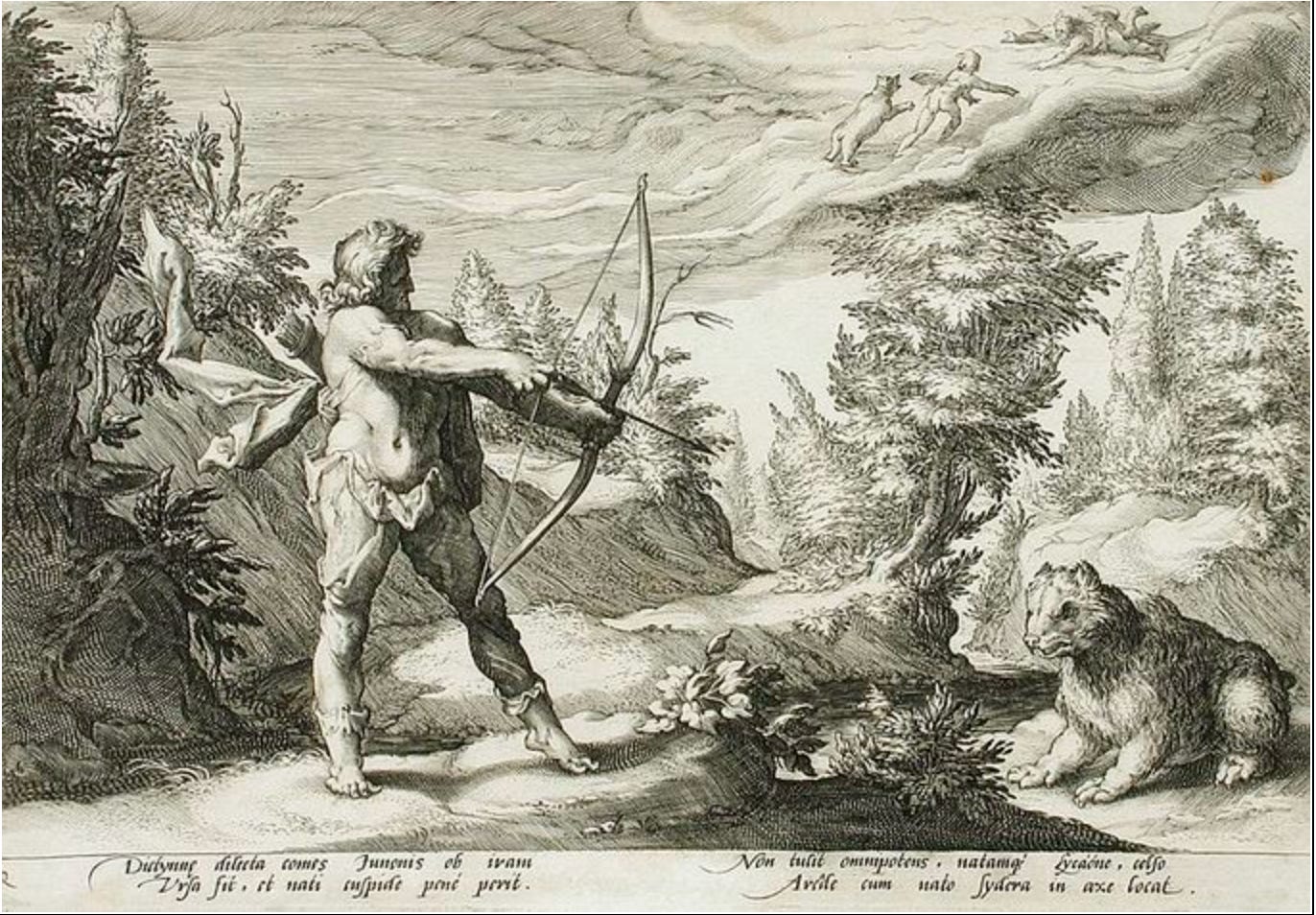
Just before he lets the arrow fly, Zeus takes action. Callisto and Arcas are launched into the sky and seated in the heavens as the constellations Ursa Major and Ursa Minor. These translate into the Great Bear and the Little Bear. How sweet, mother and estranged son hovering in the night sky. Together. Forever.
(It’s best to imagine Ursula from The Little Mermaid saying those last two words. The affect is spot on.)
Callisto has rotten luck. A devoted follower, she’s duped into falling for Zeus’ disguise. A violated woman, she is exiled by the goddess she’s devoted to. A pregnant woman, she’s cursed by the adulterer’s wife. A beast in the wild, she’s hunted and nearly killed by the one she gave life to.
Had she come across a bear in the woods, she would have been in far less danger. A wise bear might even have feared her, not knowing if cubs were nearby. Triggering the mama bear instinct doesn’t bode well for bears or men. That statement holds up two thousand years on.
Like Daphne transformed into the laurel tree, we have to ask: Was becoming a constellation — of a bear no less — helpful to her? Would she have chosen to leap into the skies to become an abstract version of her cursed self? Would Callisto have wanted her living, human son to share her fate and celestial form?
The woman’s mind locked in a bear’s body must have thought the following in quick succession:
Upon encountering a hunter in the woods: Shit. I knew I should have hibernated another week.
Upon realizing who the hunter is: Well, that’s just perfect — well played, Hera. How poetic for the spawn of Zeus to slay the victim of Zeus’ unwanted advances. Someone will probably turn this into a tragedy to perform at the Dionysia and win first place.
Upon finding herself a constellation with her son: You MUST be kidding me. Zeus is the actual worst. I cannot bear that guy.
Callisto’s story bothers me in three ways:
Her voice (read: power) gets taken away not once but twice! First, she is robbed of words when cursed to be a bear. Then, her grunts and roars get silenced when she becomes a constellation.
She never explores the power she has as a bear. If you’ve ever seen Disney’s Brave, you’ll know that bears can be pretty terrifying and wreak plenty of havoc. Why not irritate Artemis and keep popping up as a bear after being exiled as a nymph? Why not develop a taste for peacocks and cows? Making a meal out of these two significant symbols associated with Hera would send a pretty strong message.
Why does Hera get her way in the end? It’s infuriating to see Callisto blamed for Zeus’ assault and infidelity. But it’s enraging to see Zeus “save” Callisto by casting her into the heavens in her cursed form! And her son, too! Far be it from Hera to believe any of the women weren’t a) interested in Zeus to begin with, b) planning on becoming single mothers, c) hoping to incur the wrath of any god. The symbolism of Hera getting her way triggers reflexive eye rolls for me.
So, we must conclude Callisto would have chosen the bear not once but twice in this narrative:
Instead of meeting Zeus-as-Artiemis
Instead of meeting her son, Arcas
Io + Zeus
Io was a beautiful mortal woman. Therefore, Zeus had to have her for himself. After the whole Callisto incident, Zeus knew he’d need to be a bit more careful with future liaisons. But Hera knew the signs all too well and paid very close attention to her husband’s every move.
Zeus knew that his wife knew, but he was pretty sure that his wife didn’t know that he knew that she knew. And if that’s confusing, it should be. Their relationship was a constant back-and-forth of gotchas and psychological tricks. So, he took extra precautions to conceal his affair with Io by turning her into a heifer.
Zeus is rolling the dice here. He wants to protect Io from Hera’s jealousy, so he turns Io into something sacred to Hera. Hera hearts heifers. While she’s a sucker for a beautiful bovine, Hera is also skeptical and totally untrusting when it comes to anything involving Zeus.
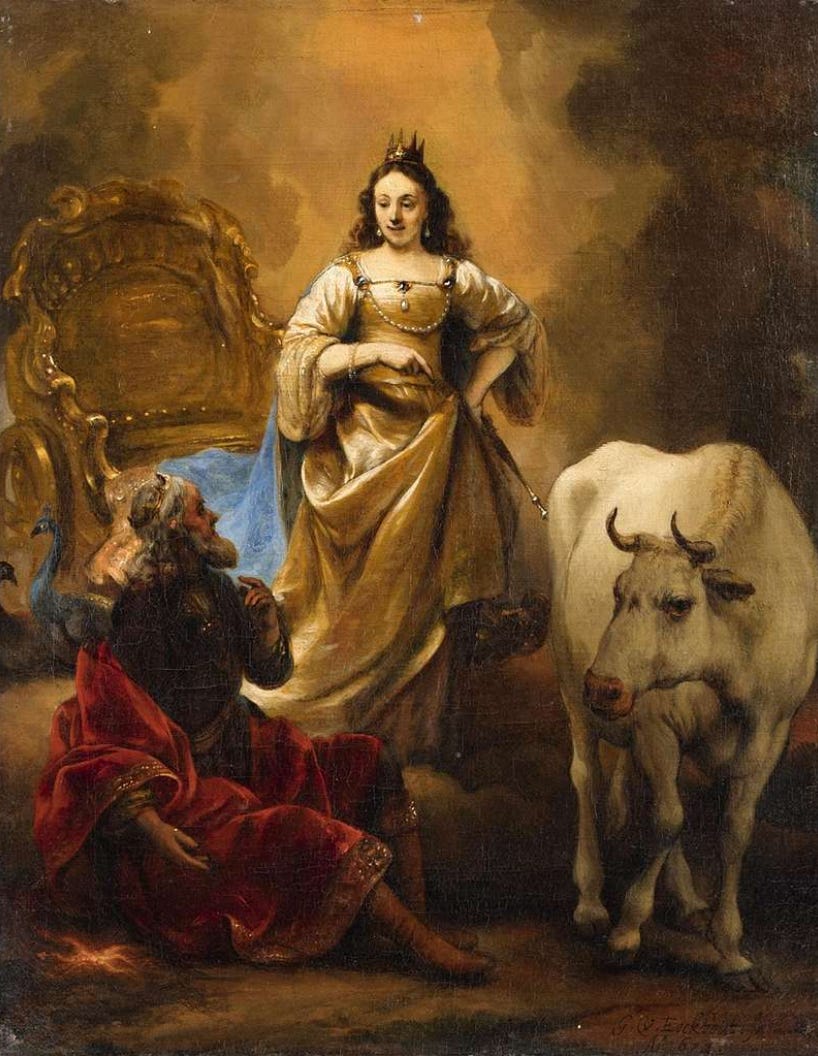
What’s unique about Io is that her reactions are part of the story. Daphne and Callisto’s inner thoughts and responses are a total mystery to us. Perhaps this is the difference between nymphs and mortals. Nymphs’ thoughts are entirely opaque to us. Who knows what goes on in their moderately deified minds? Not gods and not men. And, by extension, not us.
Bit of a sidebar about nymphs here
To draw a clear distinction between mortal women and nymphs, let’s quickly discuss the cast of noteworthy female characters across classical literature like Ovid’s Metamorphoses, Virgil’s Georgics, and Homer’s Odessey and Iliad:
Nymph name: Echo
Myth: Echo falls in love with Narcissus. Don’t judge. He’s gorgeous. You’d be head-over-heels too. Narcissus rejects Echo. Turns out he’s not so beautiful on the inside. The guy is pretty obtuse and very into himself. Honestly, if Echo had a good therapist, she might have been able to see that she’d been spared. Alas, meaningful conversations about mental health were still two millennia away, and the jury is out as to whether they’re actually happening now. Heartbroken Echo’s unrequited love and unsupported mental state cause such pain that she wastes away until only her voice remains.
Role: Echo’s role is ultimately to be deeply hurt. Her experience says something about beauty, cruelty, and despair. And also the importance of mental health.
Personal Expression: Forlorn femme
Fate: Losing one’s voice is synonymous with losing power in many myths. Echo’s fate produces the same effect: She becomes invisible and reduced to a mimicking response.
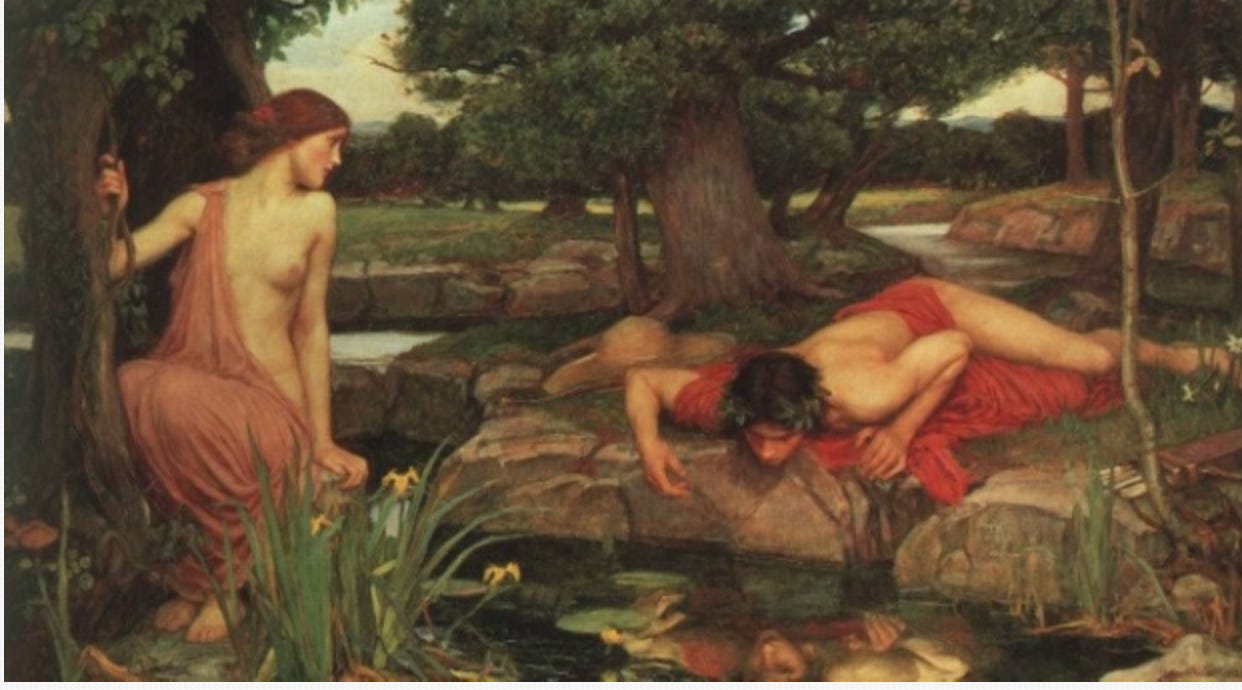
Author: Ovid, Metamorphoses
Nymph name: Calypso
Myth: Calypso holds Odysseus captive for years on her island. Odysseus probably could have gotten away at any time, but he keeps getting…let’s go with…distracted. If it wasn’t clear that distracted is a euphemism for something smutty, well, now you know.
The goddess Athena has to step in after she notices Odysseus has been gone for a while. Hermes, the messenger of the gods, is dispatched to the original Love Island and tells him to get a move on so the plot of The Odyssey can advance.
Role: Cloying, lonely nymph
Personal Expression: Desirous and desiring
Fate: No one knows. Once Hermes arrives and tells Odysseus he’s been dumped from the island, Calypso’s story ends. But she’s immortal; her story continues without being told.
In Love Island parlance: In fairness, it looks like the only connection Calypso made was with the π-Fi.
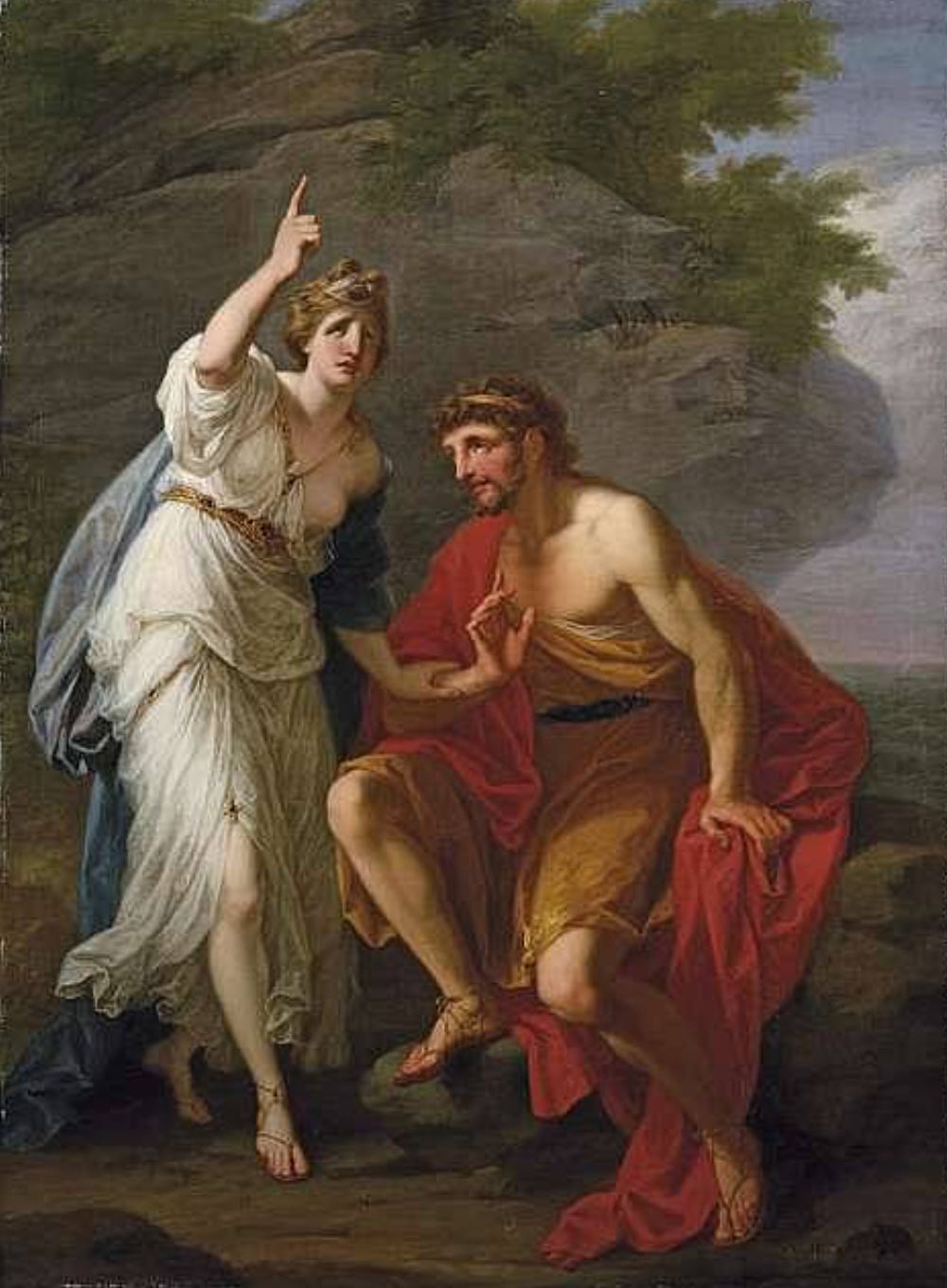
Author: Homer, The Odessy
Fun Tid Bit: One of Hermes’ roles is to guide souls to the river Styx and ensure they cross into Hades. This job comes with the best title ever — psychopomp. Going forward, let’s all agree to refer to anyone whose purpose seems to be proverbially leading the way to hell as psychopomps. Please help me make this a thing.
Nymph name: Eurydice
Myth: Eurydice and Orpheus, the famed musician and poet, fall head over heels for each other and get married. Their marriage is joyful but brief. Eurydice is running through a meadow, fleeing either a creature or Aristaeus, son of Apollo.
*Clutches pearls* The son of a god making an unwanted advance on a woman! Well, I never!
Accounts differ, but no one should be shocked that the creature pursuing Eurydice is Aristaeus.
Eurydice flees and steps on a venomous snake. She’s bitten. It’s fatal. Everyone’s favorite psychopomp shows up and escorts her to Hades. Orpheus is beyond bereft. He goes to the underworld and appeals to Persephone and Hades. So moved by his mournful melodies, the king and queen of the underworld let Orpheus bring Eurydice back. But there’s a catch…
Role: Follower.
Personal Expression: In most tellings, almost none.
Fate: Orpheus cannot look behind him to see if Eurydice follows. They get so close! But Orpheus just has to glance back when they are steps away from the upper world. Eurydice vanishes. She dies twice. Like Buffy.
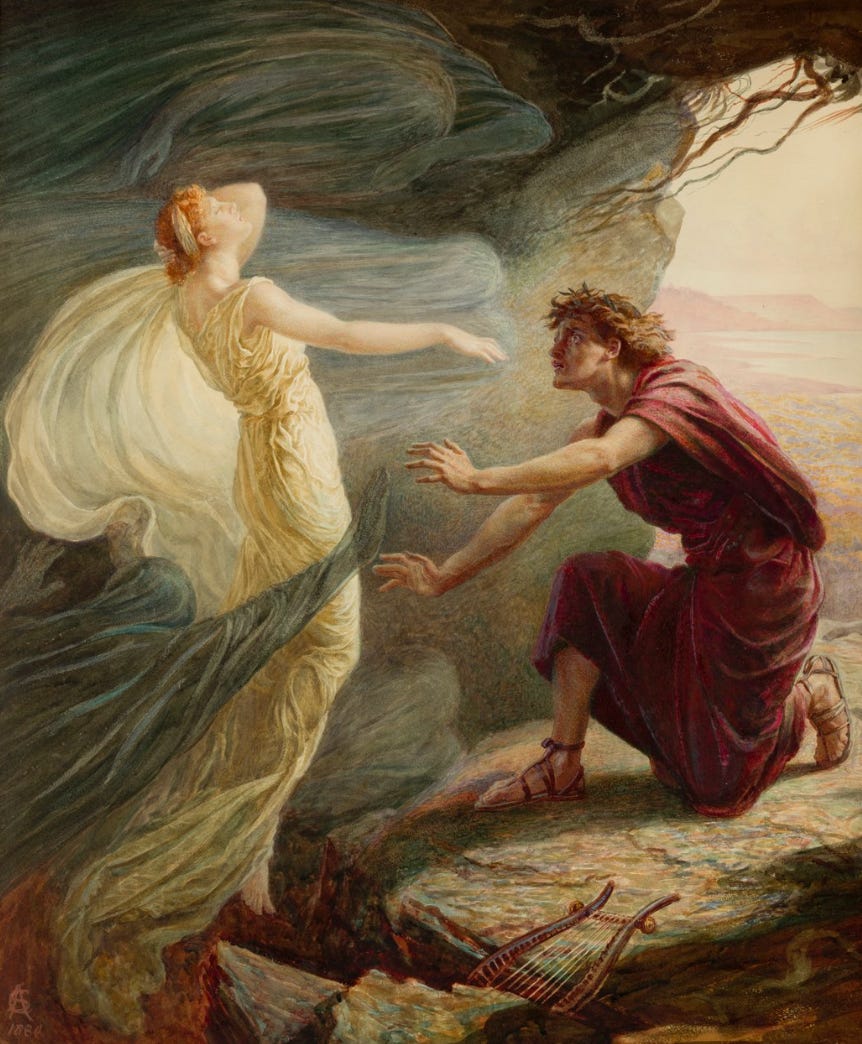
Author: Virgil, Georgics
In summary, nymphs’ stories involve vanishing acts: They disappear physically, leaving only the faintest sound; their stories end abruptly when the spotlight follows the main (male) character to another scene; they die repeatedly because of the weakness and whims of others.
And now back to the story of a mortal woman
As a woman, Io has a sense of self. She knows her own voice, her face, and her physical being. After all, she is beautiful, and there’s much ado about her loveliness. Not to mention, Zeus has the hots for her. So when she tries to speak and produces only lowing, her rational mind thinks, “Well, that seems a bit odd. I better look into this situation.”
She does look. She looks into a river to see her reflection, and (I’m very sorry about the expression that follows this parenthetical) she has an absolute cow. Io runs off through the woods in a panic.
The jig is up, and Hera knows this is no ordinary cow. Hera’s perfectly fine with Io running anywhere except to Zeus. But to ensure she knows Io’s whereabouts, Hera sends the many-eyed giant, Argus, to follow her.
Now Zeus is feeling really bad about the whole situation. Io’s freaked out. Hera is pissed (again). And to add to all this, there’s an all-seeing spy following Io. What’s the king of the gods to do in a situation he created and is entirely responsible for?
Get someone else to deal with it.
Zeus brings in the only guy he can trust at a time like this: A psychopomp.
Hermes dresses up as a shepherd and reads Argus bedtime stories until the giant falls asleep. Then Hermes kills him — permanent goodnight. Once Hera gets word of this, she’s pissed (again).
But does she take her rage out on Hermes, who killed Argus?
No.
Does she aim her righteous anger at Zeus, who enlisted Hermes as the hitman?
No.
Does Hera misplace her rage altogether and blame the victim, Io, by sending a gadfly to torment the poor cow of a woman constantly?
Yes.
Also, please don’t read that description as an insult. Io is literally a woman trapped in a cow’s hide.
Io wanders through forests and mountains, hoping all the time to rid herself of the gadfly and — we suspect — avoid all bears and men. She eventually hooves it to Egypt. It’s only then that it dawns on Zeus that maybe, just maybe, things would be easier for Io if she were a woman again.
Better late than never?
Io’s tale puts a couple of interesting spins on the man-or-bear question. First, Zeus — the man in this allegory — has to transform himself into something that will not worry or concern Io.
Let’s recap that last line for emphasis: Two thousand years ago, a man had the self-awareness to realize he would need to transform himself into something other than a man so that he was non-threatening to a woman. In Zeus’ case, that thing was a cloud.
Secondly…That’s a weird choice, right? Clouds can be seriously threatening: thunder and lightning and all that. And yet, it’s a logical choice for Zeus since lightning bolts are totally his thing. But since Io didn’t bolt (apologies for the obvious, but — be honest — perfectly applied, pun), we can assume it was not a storm cloud disguise.
In the context of the man-or-bear question women have been asking and answering of late, Zeus’s cloud transformation is even more poignant: This man is changeable and unpredictable. Are those puffy white clouds the backdrop to a perfect day, or do they precede a violent storm?
Io’s story pulls one thread all the way through these examples: We don’t know what the woman in the story would have wanted. No one asked, so no one answered. Over and over and over again, the women in these stories are subject to whatever fate befalls them.
Those fates can be bizarre — these are myths, after all. The drama and absurdity can be so extreme that it risks gaslighting readers into thinking things like:
“Whew! Good thing Peneus turned Daphne into a laurel tree just in the nick of time!”
“Thank goodness Zeus intervened before Callisto was killed by her own son! So sweet that they’re together forever in the sky.”
“For he’s a jolly good fellow. For he’s a jolly good fellow. For he’s a jolly good fellow…for returning the woman he transformed into a cow to hide his adultery from his jealous and vengeful wife, but it didn’t really go as planned back into a woman…so let’s all worship Zeus!”
What are the odds?
Statistically speaking, meeting a bear in the woods is an absurd scenario. Globally, there are an average of 3.2 bear-caused fatalities annually. For a world population of eight billion, that makes the odds of being killed by a bear 1:2.5 billion.
By comparison, the odds of being killed by a human are 6.1 per 100,000 people, or 1:16,393, which means you are 152.5 times more likely to be killed by a human than by a bear.
But not all encounters are deadly. (Hooray?) So what are the odds of simply being attacked?
Petpedia says the odds of being attacked by a bear are 1:2.1 million. Less reassuring than the odds of 1:2.5 billion, but still favorable.
Meanwhile, global estimates suggest that one in three women will be assaulted by a man in their lifetime. That means women are 700,000 times more likely to be assaulted by a man than attacked by a bear.
To be fair…there are 20,000 times more men than bears on Earth today. So, while the exponential odds are an eye-popping number, it’s also a volume game. Which, by the way, doesn’t make women feel any better.
The number that cannot accurately be represented is the number of men who would never threaten or endanger a woman. I want to believe they are out there in droves, and I’m very lucky that my personal experience supports this idea. But when it comes to human interaction, people are so changeable, and situations evoke different facets of human character.
In this way, Olympian gods and mortals are exactly the same. No amount of empirical data dating back from time out of mind could calculate odds that factor in situational factors.
The bear is the data-driven choice. What rational person chooses a more likely threat? Humans are quite literally biologically wired to choose scenarios that are most likely to preserve safety or reduce the threat level. The numbers bear out (I’m so sorry…it’s a completely unavoidable pun.) that encountering a man in the woods is a riskier prospect.
Women posting and commenting about the man or bear question aren’t universally quoting statistics to defend why they chose the bear. Like Daphne, Callisto, and Io, they’ve been chased, tricked, shunned, hurt, and blamed. Their choice comes from experience.
The conversation the man or bear question started speaks for two millennia of absent voices. Though our worlds are very far apart on a timeline, the stories handed down through the centuries are deeply relatable to many women. The similarities can be unnervingly strong.
There’s one difference we can be certain of: How ancient women would have announced they chose the bear.
“Ursum elegi.”